Speaker Types for Mobile Entertainers: A Guide
Audio, Speaker Types, Mobile Entertainers
Speaker Types Explained: From Powered to Floor Monitors (and the Best Picks for Mobile Entertainers)
If you’re a mobile entertainer—a hypnotist, juggler, magician, or variety performer—your sound system can make or break your show. This friendly guide walks you through the main Speaker Types, from powered and non-powered speakers to ceiling speakers and floor monitors, then helps you choose the Best Speakers For Performers who are constantly on the move.
The Two Big Families: Powered vs. Non-Powered Speakers
When people talk about Speaker Types, the first big divide is between powered (active) speakers and non-powered (passive) speakers. Understanding this difference makes the rest of the speaker world much easier to navigate—especially if you’re a Mobile Entertainer who needs gear that’s reliable and quick to set up in unfamiliar venues.
Powered Speakers (Active Speakers)
Powered Speakers have a built-in amplifier. That means you plug power into the speaker itself, connect your microphone, mixer, or audio source, and you’re ready to go. No separate amp rack, fewer cables, and a lot less to worry about during a hectic load-in before a show.
Plug-and-play simplicity: Great for solo entertainers who don’t travel with a sound tech.
Optimized sound: The internal amp is designed to match the speaker, so you get consistent, reliable performance with minimal tweaking.
Extra features: Many modern powered speakers include Bluetooth, basic mixing controls, and even app-based EQ and DSP (digital signal processing).
For 2026 and beyond, the trend is clearly toward smarter, more integrated powered speakers. Brands are adding wireless connectivity, onboard mixers, and even AI-driven processing—perfect for entertainers who want to pack light but sound big.
Non-Powered Speakers (Passive Speakers)
Non-powered or passive speakers don’t have an internal amp. They rely on an external amplifier or powered mixer to drive them. You’ll usually see these in permanent installations or larger touring rigs where a sound engineer is in charge of matching amps, crossovers, and speakers for maximum control and flexibility.
More modular: You can upgrade or swap amps and speakers separately as your needs grow.
Great for big systems: Ideal for theaters, big stages, and high-end installations where a pro is handling the setup.
For a typical hypnotist or juggler doing corporate events, school shows, fairs, and private parties, passive systems are usually more complexity than you need. Powered Speakers are almost always the more practical choice in the “Best Speakers For Performers” conversation—especially if you’re setting up alone.
Common Speaker Types: From Ceiling Speakers to Floor Monitors
Once you understand powered vs. non-powered, the next step is learning the main physical Speaker Types you’ll encounter. Each style is designed for a slightly different job, and knowing the difference helps you pick the right tool for your show.
Ceiling Speakers and In-Wall Speakers
Ceiling speakers and in-wall speakers are typically built for permanent installation. They’re popular in restaurants, hotels, and conference centers because they stay out of sight while providing background music or speech reinforcement across a wide area. They can be powered or passive, but they’re almost never something you’d pack in your road case as a Mobile Entertainer.
Pros: Clean look, wide coverage, great for venues that host many different events.
Cons for performers: You can’t move them, and they’re rarely voiced for impactful, up-front show sound.
If you perform in a room that already has ceiling speakers, you might be able to plug into the house system—but the sound often feels distant and less engaging than a dedicated PA pointed directly at your audience.
Bookshelf, Home, and Studio Speakers
Bookshelf speakers and studio monitors are designed for close-up listening in living rooms and studios. They can be powered or passive, and they’re wonderful for editing your show audio, building backing tracks, or rehearsing at home. But they’re not built to fill a gymnasium or outdoor fairground with sound on their own.
PA Tops and Full-Range Speakers
When performers talk about “speakers,” they usually mean PA tops or full-range speakers. These are the main speakers you put on stands to project your voice and music out to the crowd. They come in different sizes (8", 10", 12", 15") and in both powered and non-powered versions.
Great for: Spoken word, backing tracks, music intros, and sound effects—exactly what hypnotists and jugglers need.
Typical choice: Most Mobile Entertainers choose 8"–12" Powered Speakers as their main PA.
Subwoofers
Subwoofers handle the deep bass frequencies that full-range speakers can’t reproduce at high volume. DJs and bands often rely on them to get that chest-thumping low end. For a hypnotist or juggler, a sub is usually optional unless your show heavily features music with big bass drops or you perform in very large spaces where extra low-end helps carry the sound.
Floor Monitors (Stage Monitors)
Floor monitors are angled speakers that sit on the stage facing back toward you so you can clearly hear your own voice and music. They’re crucial on loud stages where the main PA is pointed away from you. Many modern Powered Speakers are designed to double as both PA tops and floor monitors, simply by placing them on their side using a wedge angle built into the cabinet.
Why they matter: If you can’t hear yourself, your timing, pacing, and audience interaction suffer—especially in comedy and hypnosis routines.
Column and Tower PA Systems
Column PAs—slim vertical speakers on top of a compact base or subwoofer—have become very popular with solo performers. Systems like the Yorkville YXL Tower series offer a tall column of small drivers that spread sound evenly across the room, often with an integrated mixer and multiple “voicing” modes for speech, music, or live performance. They’re sleek, easy to carry, and visually unobtrusive, which can be a big plus for corporate shows and weddings.
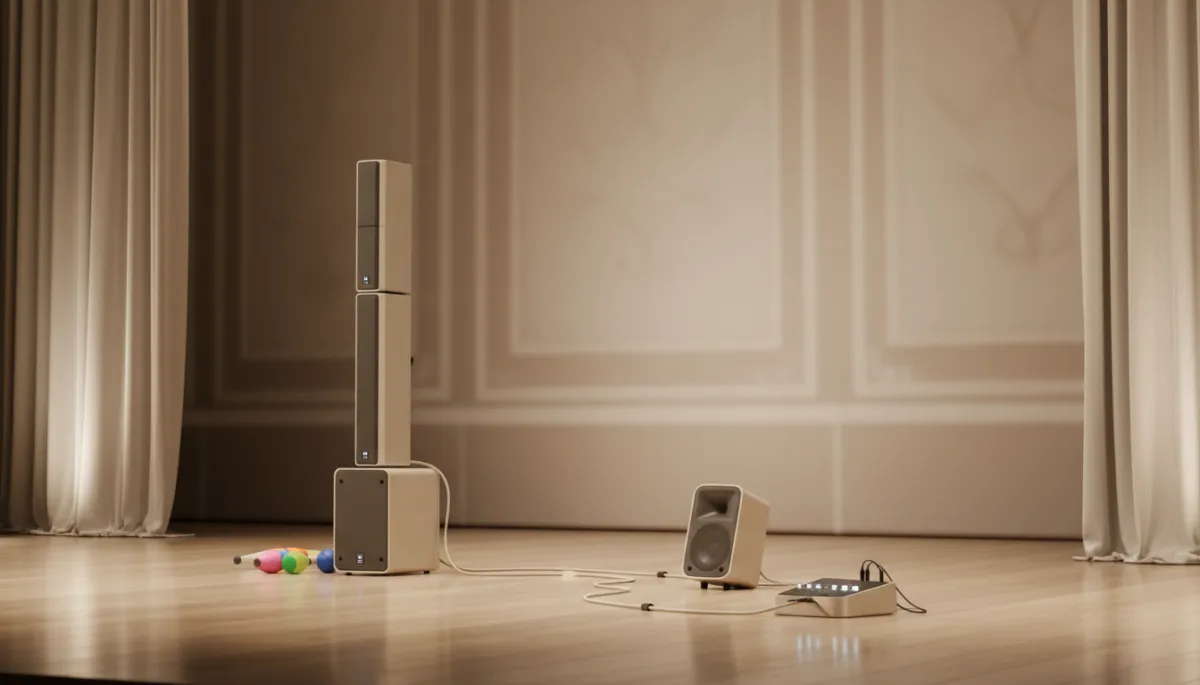
Compact powered speakers and column PAs keep setups fast, tidy, and professional for mobile shows.
What Mobile Entertainers Really Need from Their Speakers
Now that we’ve defined the main Speaker Types, let’s talk about what actually matters day-to-day for a working Mobile Entertainer. Whether you’re a hypnotist, juggler, magician, or multi-talented variety act, your priorities are a bit different from a rock band or nightclub DJ.
Clarity of Voice Comes First
Your voice is the star of the show. Hypnotists need every suggestion to land clearly. Jugglers and variety performers rely on jokes, instructions, and audience interaction. So the Best Speakers For Performers in this category put speech clarity ahead of earth-shaking bass. Look for speakers with:
Smooth, natural mids where the human voice lives.
Simple EQ presets for “speech” or “presentation.”
Portability and Fast Setup
You might be in a school gym one day and a hotel ballroom the next. Lugging around heavy racks and complex cabling is a quick route to burnout. For most Mobile Entertainers, a compact pair of Powered Speakers with an integrated mixer—or a single battery-powered PA—hits the sweet spot between sound quality and convenience.
Reliability and Battery Power Options
Outdoor fairs, parades, and pop-up events are part of the job for many performers. That’s where modern battery-powered Powered Speakers shine. Newer systems can run for 12–40 hours on a charge, and many are weather-resistant enough for outdoor use—just in case the clouds decide to join your show.
Top Speaker Picks for Mobile Entertainers in 2026
Let’s connect all of this to some real-world options. Based on recent reviews and industry coverage, here are some of the Best Speakers For Performers—especially mobile entertainers who need a blend of portability, clarity, and reliability.
All-in-One Battery-Powered PA Favorites
For solo performers who want to roll in with a single speaker and still sound professional, these battery-powered Powered Speakers are standouts:
Electro‑Voice Everse 8: Frequently praised as one of the best all-round battery-powered PA systems, the Everse 8 offers clean, powerful sound, flexible inputs, and app-controlled DSP. It’s ideal for outdoor shows, street performances, and small to mid-size rooms where you want quick setup and pro-grade clarity.
Bose S1 Pro+: Bose’s compact PA includes built-in wireless receivers for mics and instruments, plus app-based control over EQ and effects. It’s an excellent match for hypnotists and MC-style entertainers who rely heavily on microphones and want minimal visible gear on stage.
Mackie Thump GO: A rugged, battery-powered speaker with up to 12 hours of use, Bluetooth streaming, and a simple integrated mixer. It’s a budget-friendly option that still delivers enough volume and clarity for many school and community events.
High-Performance Powered Speakers for Frequent Performers
If you’re performing several times a week and want a system that can scale from small rooms to larger venues, a pair of compact, mains-powered Powered Speakers is a smart investment:
QSC K8.2: This compact 8" Powered Speaker packs a 2,000W Class-D amplifier and advanced DSP with presets for speech, music, and more. It’s lightweight, rugged, and can double as a main speaker or a floor monitor. For mobile entertainers who want a “buy once, cry once” solution, a pair of K8.2s on stands is a long-term workhorse.
QSC CB10: A newer portable 10" loudspeaker with up to 440W peak power, built-in mixer, Bluetooth, and app control. It’s designed with mobile rigs in mind and offers around 12 hours of battery life when used as a standalone unit, making it a flexible choice for both indoor and outdoor shows.
Rugged Outdoor and High-Volume Options
For fairs, festivals, and street shows where you need to project over crowds and background noise, these Speaker Types shine:
Soundboks Mix: A battery-powered beast rated up to 121 dB with IP65 weather resistance and up to 40 hours of battery life. While it’s often marketed as a party speaker, its sheer volume and rugged build make it a strong candidate for outdoor Mobile Entertainers who need to be heard clearly over a busy midway.
Marshall Bromley 450: With up to 40 hours of playtime, multiple input options, and an IP55-rated enclosure, this stylish speaker offers both aesthetics and durability. It’s a nice fit for entertainers who want their gear to look as good as it sounds at upscale events or private parties.
Wireless Flexibility for Fast, Cable-Free Setups
If you hate wrestling with cables or often set up in unusual spaces, newer wireless-focused Speaker Types may appeal to you:
Dillinger Labs “Death From Above” SKAA speakers: These battery-powered speakers use SKAA wireless technology for low-latency, reliable audio, and are sold in pairs. They’re aimed at mobile DJs, but the same strengths—quick deployment and cable-free setups—benefit entertainers who move between stages or perform in venues with limited power access.
Electrotec Audio Stage One: Another SKAA-based system recognized with a NAMM “Best in Show” award, Stage One combines concert-grade performance with robust wireless connectivity. It’s a forward-looking choice if you see yourself building a more advanced, cable-light rig over the next few years.
Matching Speaker Types to Your Show: Practical Scenarios
To bring it all together, here are a few common situations Mobile Entertainers face, along with Speaker Types that tend to work best in each case.
School Assemblies and Gyms
You’re performing for 200–500 students in a reverberant gym. You need clear speech and enough power to reach the back row without feedback.
Recommended: A pair of 10"–12" Powered Speakers like QSC K8.2 or QSC CB10 on stands, plus a simple floor monitor (or one of the mains tilted as a monitor) so you can hear yourself clearly.
Corporate Events and Hotel Ballrooms
Here, appearance matters. You want a clean, professional look with minimal clutter, and you often have to set up quickly between other presenters.
Recommended: A sleek column PA system or compact Powered Speakers like Bose S1 Pro+ or Electrotec Stage One. These systems blend into the décor while still delivering excellent speech clarity.
If You Are Hiring a Hypnotist Or Other Performer- Read below
THE SOUND SYSTEM - AUDIO REQUIREMENTS (Technical Rider
If you do not deal with sound systems, I suggest you do not read the following. It has been known to give people headaches. If this is a one-off type event, you probably do not need to learn an entirely new vocabulary.
Hypnosis shows are verbal performances. A hypnotist talks and plays music the entire show directing the action of the volunteers on stage. A hypnosis show requires a good sound system. If (1) the audience or (2) volunteers on stage cannot hear clearly, the show can hurt.
Metaphor: If you need to move bails of straw, you would want a pick-up truck. It would not need to be a large or strong pick-up truck; a small 4-cylinder pick-up would work better than a family car. A sports car has a large engine, but would be poor at moving straw. A family van will work though it is not best.
A hypnosis show needs a simple, but specific type of sound system to do a show properly. There are exceptions and sometimes the sound system you have is not the one I am describing here, and it will work, but in general, having the right sound system increases the show's success and the sound goes unnoticed. An unnoticed sound system is good
Vocabulary:
Amplifier = the “engine” of the sound system. An amplifier is rated in Watts like an engine is rated in Horsepower. A sound system that has speakers that face the audience should be one watt per person. If the audience is 300 people, you need 300 watts. Exceptions are if the room or space can handle 800 people, then you should have enough watts to cover the room even if there are not that many people in the room, especially if the room is carpeted.
Dynamics: Having speakers that are crisp on the high end and produce a thump on the bottom end and reproduce the spoken human voice clearly while they also handle music volumes that are louder than normal listening volumes without distorting.
Monitors: Speakers that face the stage and are often placed on the floor. Monitors ensure sound heard on stage by the performer and the volunteers are first-generation, not bouncing off the back of the room, coming out of the back of the speakers, or not reaching the stage at all.
A monitor is powered by a separate amplifier. This way the volume on stage coming from the monitor can be controlled separately from the volume going to the audience through the main speakers.
A stage monitor is very important in the majority of situations. In most situations discussed below where the sound system may not work, it can work if there is a stage monitor.
Speakers: When we discuss speakers, we are discussing the diameter of the speaker. Like tractor tires, large tires help tractors perform in all types of terrain. Larger speakers also perform in all types of situations, however, tractors do not perform well on city streets because they are too big. Likewise, speakers should not be too big for the theatrical hypnosis show. 8” woofers for the bottom end reproduce voice clearly. Larger speakers make the sound too deep (good for music, singing, and dancing, bad for speaking), smaller speakers do not have enough dynamics.
There are many types of sound systems, just like there are many types of cars and trucks. Many sound systems do not do the job except in rare exceptions.
Bad Sound Systems:
Sound systems built into the ceiling of a gymnasium are usually poor sound systems for a hypnosis show. They were designed for announcing games and are not personal. The energy of the sound coming from the speakers comes from the ceiling, not from the performance. These systems are also usually designed to cover all the bleachers in a full gymnasium. when the gymnasium bleachers are not full, the sound bounces around, creating echo, and is hard to understand clearly when someone is narrating a story.
Speakers built-in to meeting rooms and banquet rooms are never sufficient. I have distorted Bose systems installed in universities that are exceptional, for what they are designed to do. They are small speakers designed for background music and calling bingo-like announcements. They work for speaking when everyone is quiet and listening but can not handle the dynamics of a hypnosis show.
DJ systems sometimes work, but it is important that speakers be placed 30 feet apart so the hypnotist is not walking in front of the speakers. He needs to stay behind the speakers or he will have feedback problems. DJs also tend to set up on the stage. If the DJ is set up on the stage, the hypnotist with 12 or more volunteers cannot also be on the same stage unless the stage is really large. DJ systems can and do often work, but the hypnotist needs to talk to the DJ before the event to be sure.
Theater sound systems are designed for plays and announcements. They have no dynamics and often do not have monitors. Sound systems in theaters have limiters and compressors and these prevent the hypnosis show from getting the dynamics needed to create excitement when the hypnotist wants a little extra energy.
Final Thoughts: Choosing the Best Speakers For Performers Like You
The world of Speaker Types can look overwhelming at first—powered vs. non-powered, ceiling speakers vs. floor monitors, columns vs. traditional PA tops. But once you focus on what matters for Mobile Entertainers, the picture gets much clearer. In most cases, the Best Speakers For Performers such as hypnotists and jugglers are:
Powered Speakers for simple, reliable setups without external amps.
Portable, full-range PA tops or compact column systems for clear voice projection.
Battery power when you frequently perform outdoors or in challenging venues.
Start by listing your typical venues, audience sizes, and how much gear you’re willing to carry. Then match those needs to one of the modern Powered Speakers or portable PA systems highlighted above. With the right speakers behind you, your voice carries farther, your jokes land better, and your show feels more polished—no matter where the road takes you next.